Matthias Kirschnereit - Pianist

News

Biography

Tour calendar

Discography

Gallery

Reviews/Interviews

Contact

Editorial
Matthias KirschnereitMatthias Kirschnereit
PRESS REVIEW


press reviews

interviews
>> Neue Zürcher Sonntagszeitung, Kai Luehrs-Kaiser - 2006.12.10
The Pianist Who Came In From the Desert
The big discovery of the Mozart Year is Matthias Kirschnereit
Taking stock of the Mozart Year yields only lean pickings: 22 of the local saint’s operas were performed – the connoisseurs are happy to have survived. Anne-Sophie Mutter nearly disgraced herself as Mozart performer. Her Mozart trios (with her ex-husband André Previn) were attested by the critics to have sales savvy but little taste.
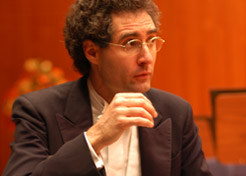
Can it be that we’re no longer able to cope with Mozart? Indeed. This jubilee has bestowed at least one Mozart talent upon us: the 44-year-old pianist. Born the son of a parish priest in a town in Westfalia and brought up in Namibia the curly-headed musician was long considered an outsider to the scene. Until this year, when he completed the cycle of all Mozart piano concertos for Arte Nova.

„Mozart’s not so cool“ says the pianist Kirschnereit

Here he strikes exactly the right tone of convincing ease and serious happiness which is so difficult to affect and which can be neither forced by virtuosity nor adopted. A feat in 21 concertos (four early “pasticcio” concertos and the concertos for two and three pianos are missing). What’s behind all this?
„Mozart’s not so cool“, says Kirschnereit in an interview. Every second of Mozart’s concerti speak of a need for affection, of vulnerability and human weakness. These ephemeral feelings disintegrate if you put pressure on the music. Mozart can only be awakened to life through “naturalness, aliveness, veracity” writes Kirschnereit in the booklet. Over a cup of coffee he adds that he doesn’t want to do anything differently. But “not wanting to do anything wrong”, to celebrate “musical correctness” with hot fingers and an even hotter head is also amiss.
This lightness has its price. No wonder that hardly anyone can play Mozart. Kirschnereit took six years’ time for the cycle. Left Beethoven well alone. And found richly-voiced and flexible partners in Frank Beermann and the Bamberg Symphony Orchestra.

A piano in a container followed him to Namibia.

Kirschnereit’s Mozart is so pointed it’s brusque. He’s absent of any magic flute mellifluousness, despite the end of times dreaminess as in the last concerto in B-flat Major KV 595. A fan of the German comedian-musician Helge-Schneider, he cultures a rhetorically absorbing and at the same time naturally-flowing Mozart. “Let it come” is his motto. One has to let Mozart flow. Considering this, these interpretations are, however, wonderfully taut and rhythmically defined.
Indeed, it’s just that certain eccentricity which caused Kirschnereit to hit the mark. The first years in Africa he tinkled the keys on his own without any instruction (a piano had followed him in a container). In the conservatory in Windhoek Bach was only practised at a later stage. And later still he allowed himself to be made fun of as “the pianist who came in from the desert”.
And yet Kirschnereit, who gives more space to the spiritual aspect of Mozart than many of his contemporaries, is not a late bloomer. He thinks little of aging Mozart discoverers like Horowitz or Michelangeli. His Mozart heroes are Murray Perahia, Maria Joao Pires and Geza Anda. His Mozart is an aggregate of foreignness and tradition. Of spontaneity and feeling. A Mozart for everyone.
„He does your soul good“, says Matthias Kirschnereit simply. Admittedly, measured according to this therapeutic argument, the Mozart Year brought little joy to the soul. With Matthias Kirschnereit’s piano concerts it at least ended well.

<< back